Turning AI conversation signals into career direction
Turning AI conversation signals into career direction
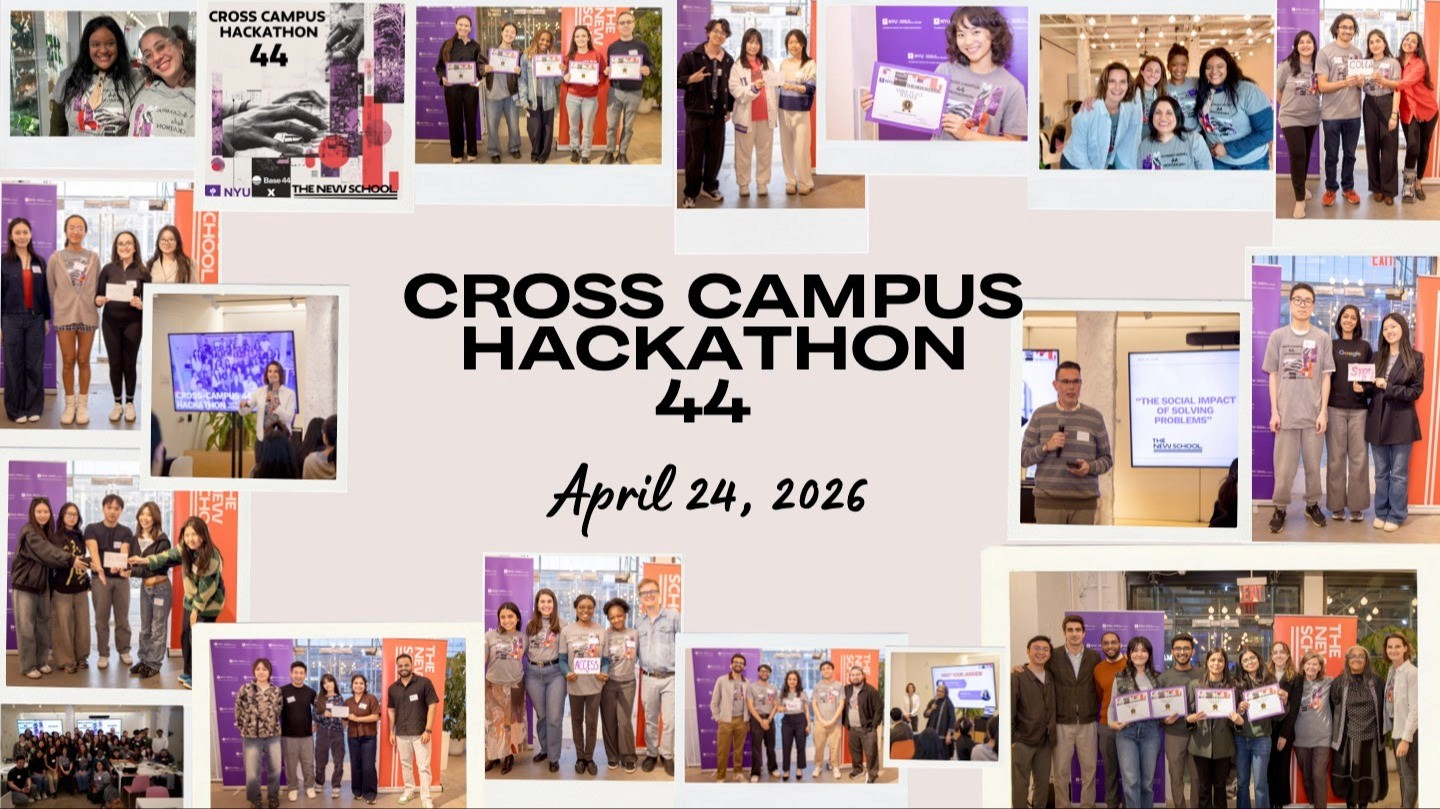
Built during The Cross Campus 44 Hackathon: A rapid prototype exploring how AI conversations can shape more personalized and intentional career discovery
Built during The Cross Campus 44 Hackathon: A rapid prototype exploring how AI conversations can shape more personalized and intentional career discovery
ROLE
Product Designer
ROLE
Product Designer
TIMELINE
1 Day
TIMELINE
1 Day
TEAM
Euijin, Kaitlyn, Jo, Darren, Julia
TEAM
Euijin, Kaitlyn, Jo, Darren, Julia
RESPONSIBILITY
Problem Framing, UX Design, Product Strategy, Synthesis, Prototyping
RESPONSIBILITY
Problem Framing, UX Design, Product Strategy, Synthesis, Prototyping
Overview
Overview
Career discovery today feels fragmented and directionless. Students move across platforms, opportunities, and applications without a clear sense of fit.
This project explores how AI conversation signals could guide more intentional career discovery. Built during The Cross Campus 44 Hackathon, Sync turns unstructured signals into personalized opportunities, direction, and momentum.
Career discovery today feels fragmented and directionless. Students move across platforms, opportunities, and applications without a clear sense of fit.
This project explores how AI conversation signals could guide more intentional career discovery. Built during The Cross Campus 44 Hackathon, Sync turns unstructured signals into personalized opportunities, direction, and momentum.
CONTEXT
Why does job searching still feel broken for students?
Why does job searching still feel broken for students?
Job searching is not only about finding listings. Students navigate cold applications, generic rejections, and career events where it is difficult to be remembered.
At the same time, companies face the same problem from the other side: they are still looking for candidates who feel aligned, motivated, and contextually relevant.
Job searching is not only about finding listings. Students navigate cold applications, generic rejections, and career events where it is difficult to be remembered.
At the same time, companies face the same problem from the other side: they are still looking for candidates who feel aligned, motivated, and contextually relevant.
The current experience creates friction on both sides
The current experience creates friction on both sides
Students apply broadly without knowing what actually fits
Companies struggle to identify candidates beyond surface-level profiles
Existing platforms prioritize listings over direction
As a result, many people struggle to build an intuitive mental model of how quantum systems behave.
As a result, many people struggle to build an intuitive mental model of how quantum systems behave.
2.RESEARCH
User Interviews
User Interviews
The problem was less about finding jobs, and more about finding direction
The problem was less about finding jobs, and more about finding direction
Through early interviews and conversations, we found that students were not simply lacking access to opportunities. They were overwhelmed by the number of platforms, unsure which opportunities were worth pursuing, and frustrated by generic matching.
Through early interviews and conversations, we found that students were not simply lacking access to opportunities. They were overwhelmed by the number of platforms, unsure which opportunities were worth pursuing, and frustrated by generic matching.
Career Anxiety
Students felt pressure to make the “right” career move without enough clarity.
Students felt pressure to make the “right” career move without enough clarity.
Information Overload
Jobs, events, internships, and programs were scattered across different platforms
Jobs, events, internships, and programs were scattered across different platforms
Impersonal Matching
Existing recommendations often felt generic and disconnected from personal goals.
Existing recommendations often felt generic and disconnected from personal goals.
Access Gaps
The most valuable opportunities were often hidden in events, networks, or smaller rooms.
The most valuable opportunities were often hidden in events, networks, or smaller rooms.
AI Trust Concerns
Students were curious about AI, but cautious about privacy and control.
Students were curious about AI, but cautious about privacy and control.
Market Research
Market Research
A competitive cycle with too little guidance
A competitive cycle with too little guidance
Market research reinforced that career anxiety is not a niche problem. Students are entering an increasingly competitive internship and entry-level market, while existing platforms still rely heavily on static listings, filters, and broad matching.
This revealed a gap between effort and outcome: students are doing more, but not necessarily moving with more direction.
Market research reinforced that career anxiety is not a niche problem. Students are entering an increasingly competitive internship and entry-level market, while existing platforms still rely heavily on static listings, filters, and broad matching.
This revealed a gap between effort and outcome: students are doing more, but not necessarily moving with more direction.
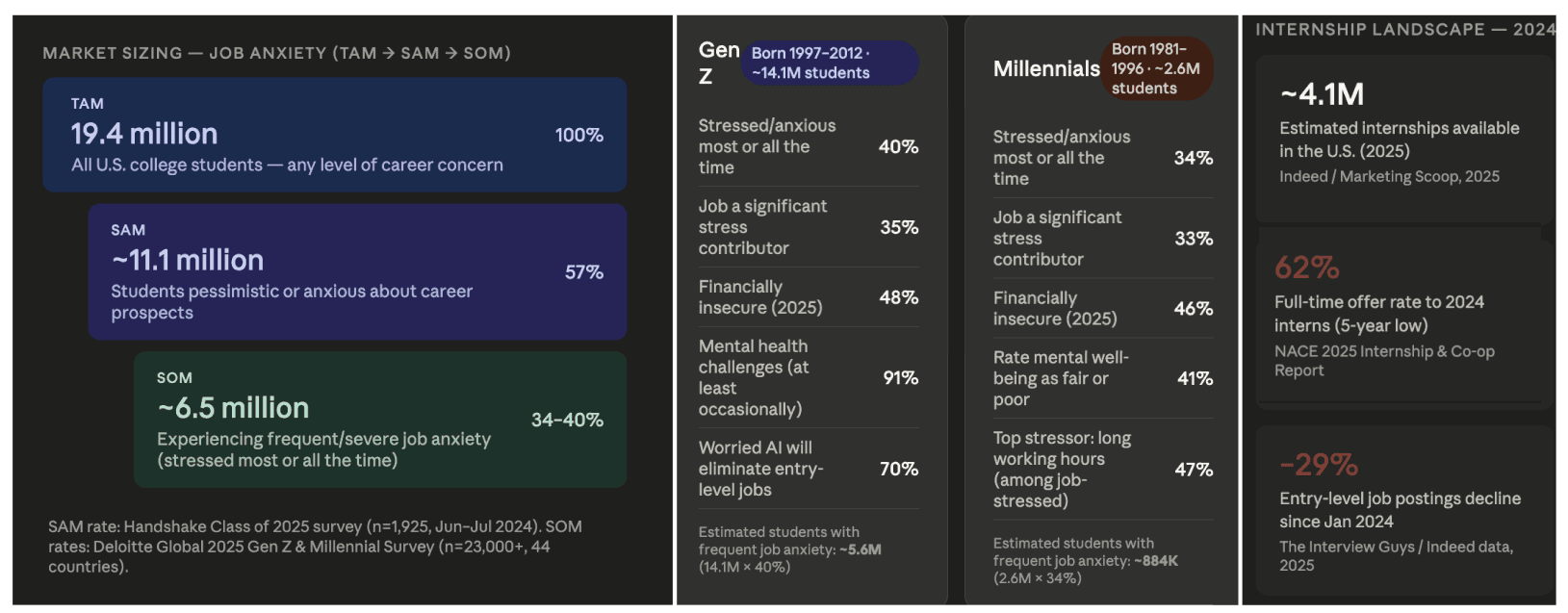
Over 6.5 Million Anxious Students
The most anxious generation EVER
The Most competitive Cycle EVER
Over 6.5 Million Anxious Students
The most anxious generation EVER
The Most competitive Cycle EVER
Career anxiety is widespread among students
Internship and entry-level opportunities are increasingly competitive
Existing platforms focus on discovery, not decision-making
Students need help understanding what is strategically worth pursuing
Career anxiety is widespread among students
Internship and entry-level opportunities are increasingly competitive
Existing platforms focus on discovery, not decision-making
Students need help understanding what is strategically worth pursuing
3.DESIGN QUESTION
How might we reduce friction in career discovery?
How might we reduce friction in career discovery?
Instead of asking students to search harder, we asked how we could use the signals they already leave behind to create clearer direction.
Instead of asking students to search harder, we asked how we could use the signals they already leave behind to create clearer direction.
" How might we turn AI conversation signals into access, direction, and acceleration? "
" How might we turn AI conversation signals into access, direction, and acceleration? "
4.DESIGN OBJECTIVES
3 frictions shaped the product direction
3 frictions shaped the product direction
From our research synthesis, we focused on three core areas where career discovery breaks down: scattered opportunities, generic matching, and hidden access.
From our research synthesis, we focused on three core areas where career discovery breaks down: scattered opportunities, generic matching, and hidden access.
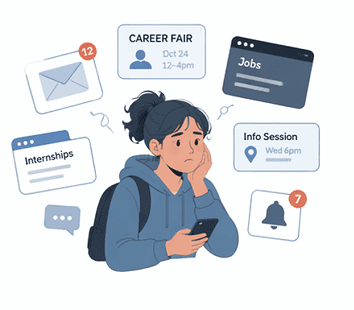
Scattered opportunites
Scattered opportunites
↓
Bring jobs, events, and programs into one ranked feed
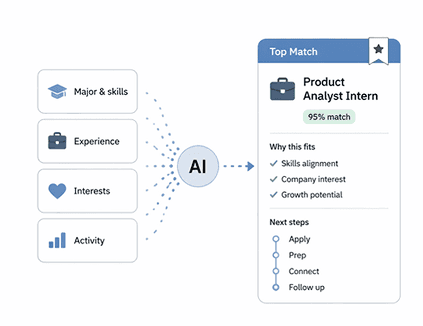
Generic Matching
Generic Matching
↓
Turn AI sights into a personalized roadmap
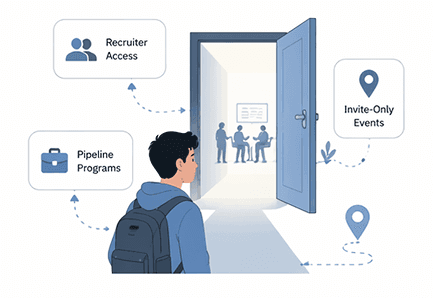
Hidden rooms
Hidden rooms
↓
Surface the right events, access signals, and speed boost
CORE INSIGHT
The strongest career signal was already outside the job board
The strongest career signal was already outside the job board
Students already talk to AI about their goals, doubts, interests, and the companies they keep circling.
These conversations often reveal more personal and directional signals than a resume or job board profile.
Sync uses those conversations as the starting point for career discovery.
Students already talk to AI about their goals, doubts, interests, and the companies they keep circling.
These conversations often reveal more personal and directional signals than a resume or job board profile.
Sync uses those conversations as the starting point for career discovery.
Your AI already knows the questions you are asking, the roles you keep returning to, and the uncertainty you may not say out loud in an interview.
Your AI already knows the questions you are asking, the roles you keep returning to, and the uncertainty you may not say out loud in an interview.
POSITIONING
From generic job boards to personalized career acceleration
From generic job boards to personalized career acceleration
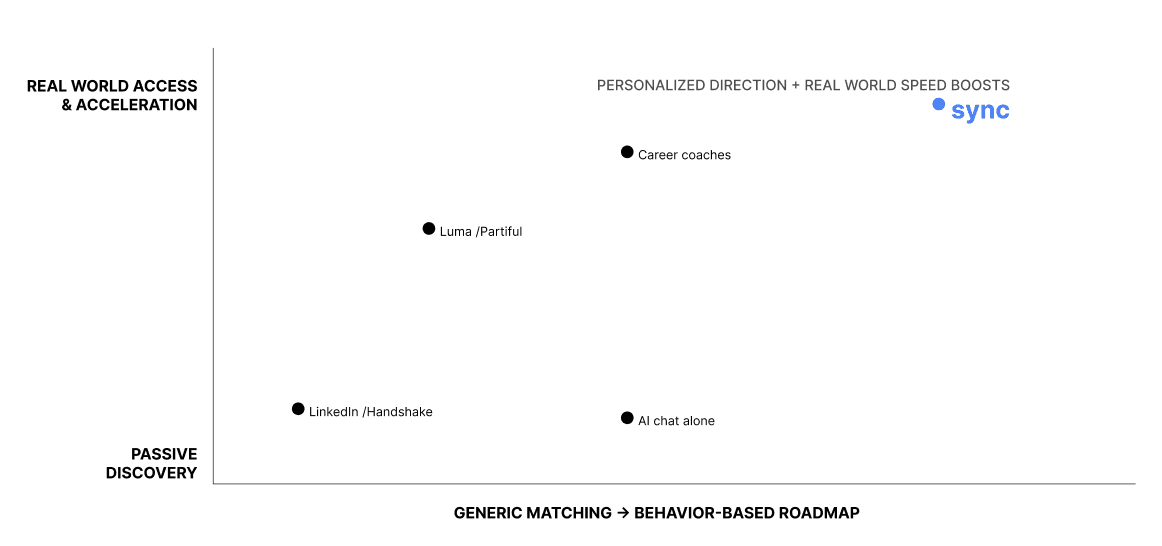
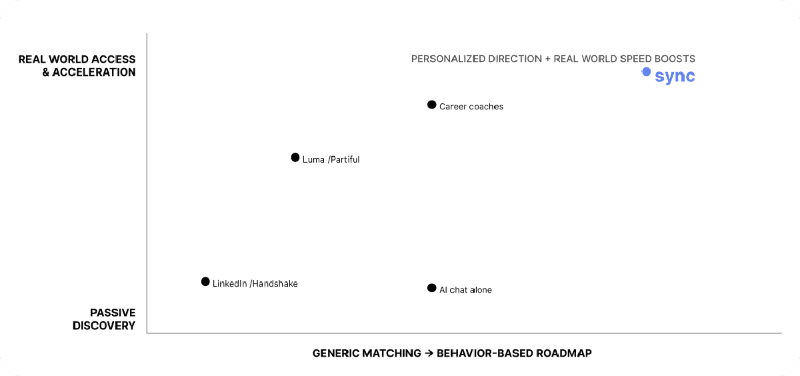
Sync is positioned between passive discovery and high-touch career coaching. It is not just a feed of listings, and it is not only an AI chat experience.
The product turns behavioral signals into real-world opportunities: jobs, events, pipeline programs, and next steps that help students move with more clarity.
Sync is positioned between passive discovery and high-touch career coaching. It is not just a feed of listings, and it is not only an AI chat experience.
The product turns behavioral signals into real-world opportunities: jobs, events, pipeline programs, and next steps that help students move with more clarity.
DESIGN SYSTEM
A calm interface for a high-anxiety process
A calm interface for a high-anxiety process
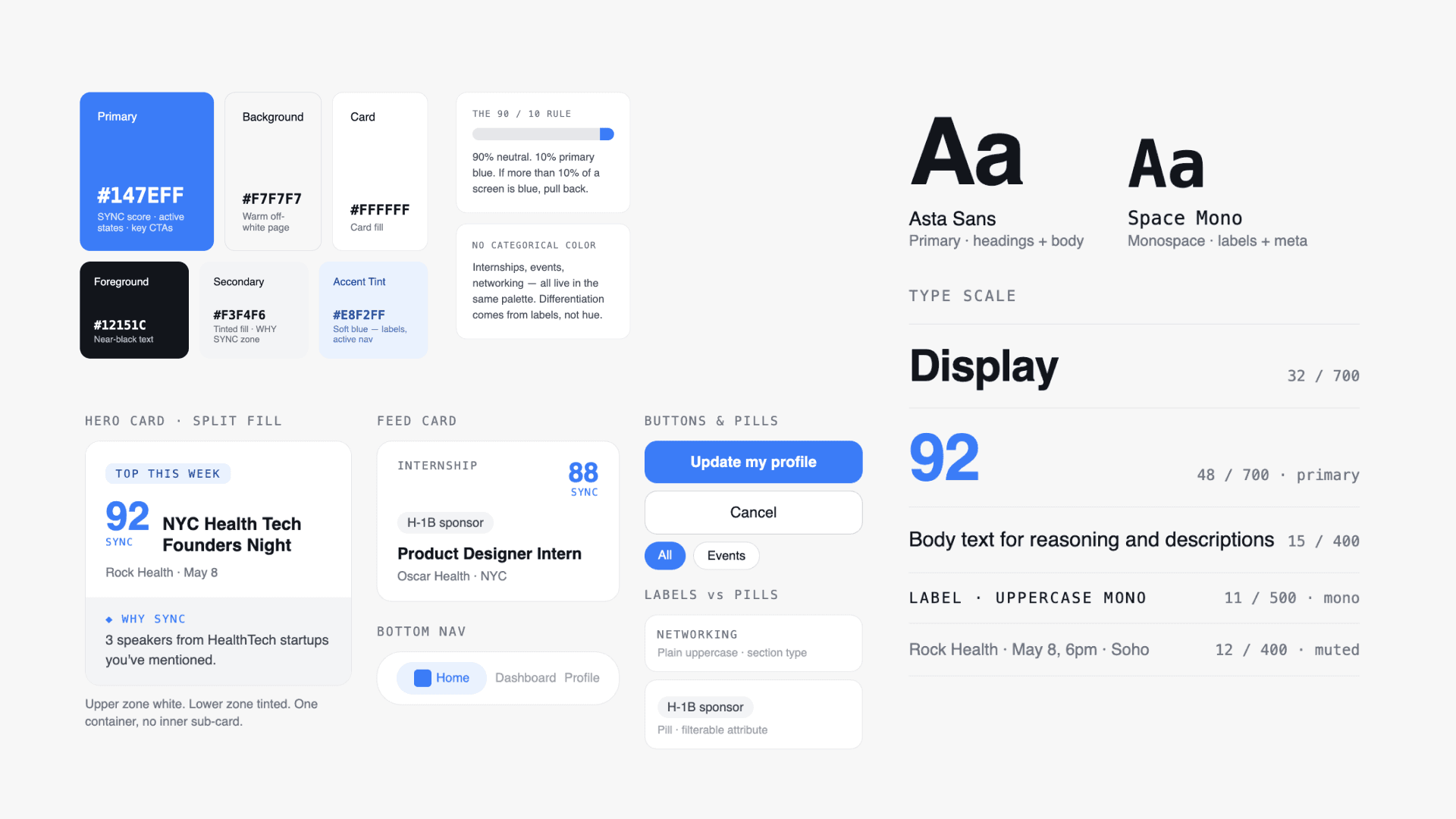
The visual system was designed to make career decisions feel clear and lightweight. A restrained color palette keeps the interface calm, while blue is used for active states, scores, and key actions.
Cards, pills, and labels were used to make opportunity comparison feel structured without adding more noise.
The visual system was designed to make career decisions feel clear and lightweight. A restrained color palette keeps the interface calm, while blue is used for active states, scores, and key actions.
Cards, pills, and labels were used to make opportunity comparison feel structured without adding more noise.
WORKFLOW - KEY FEATURES
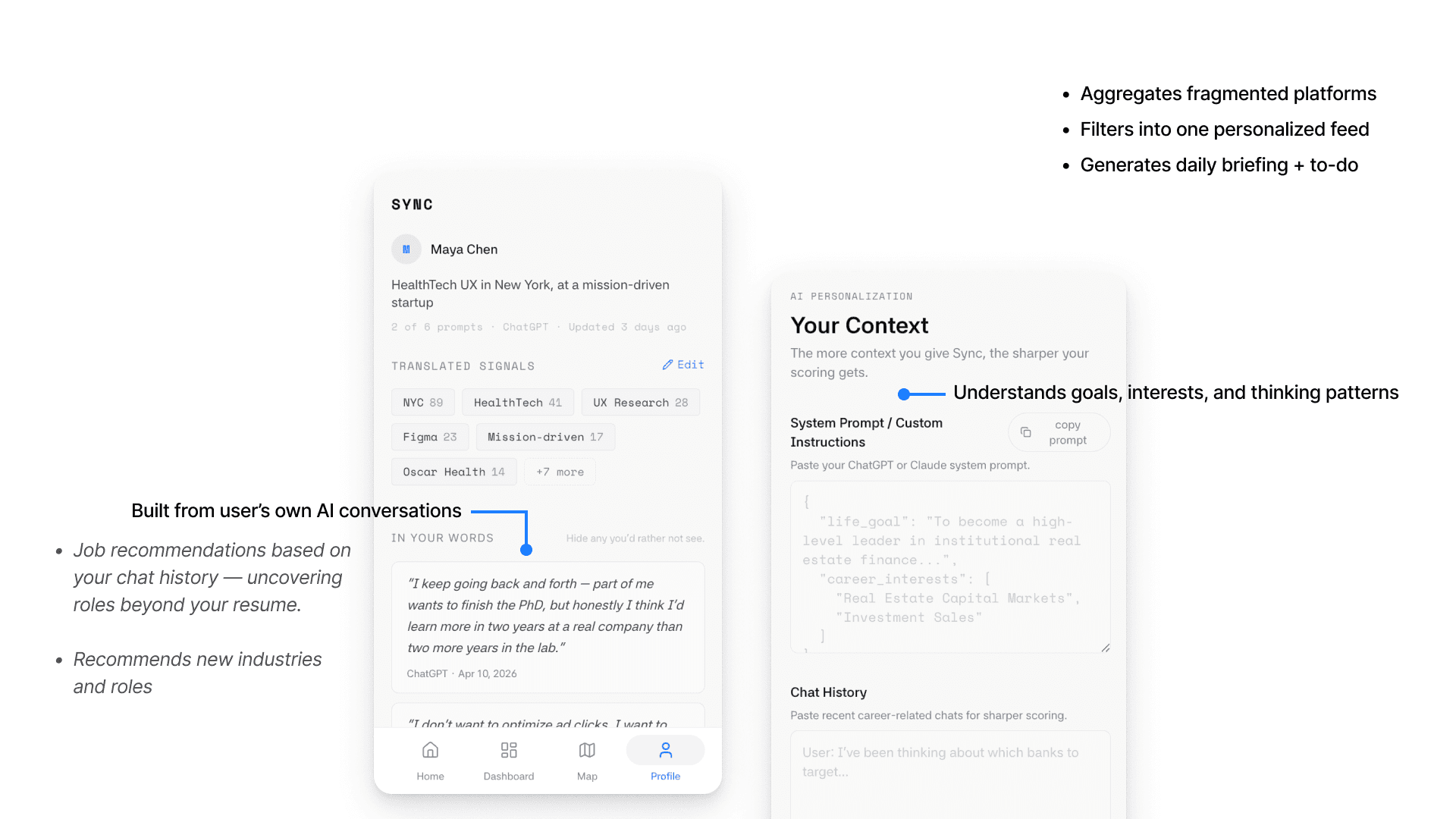
Bring Your Own LLM
Bring Your Own LLM
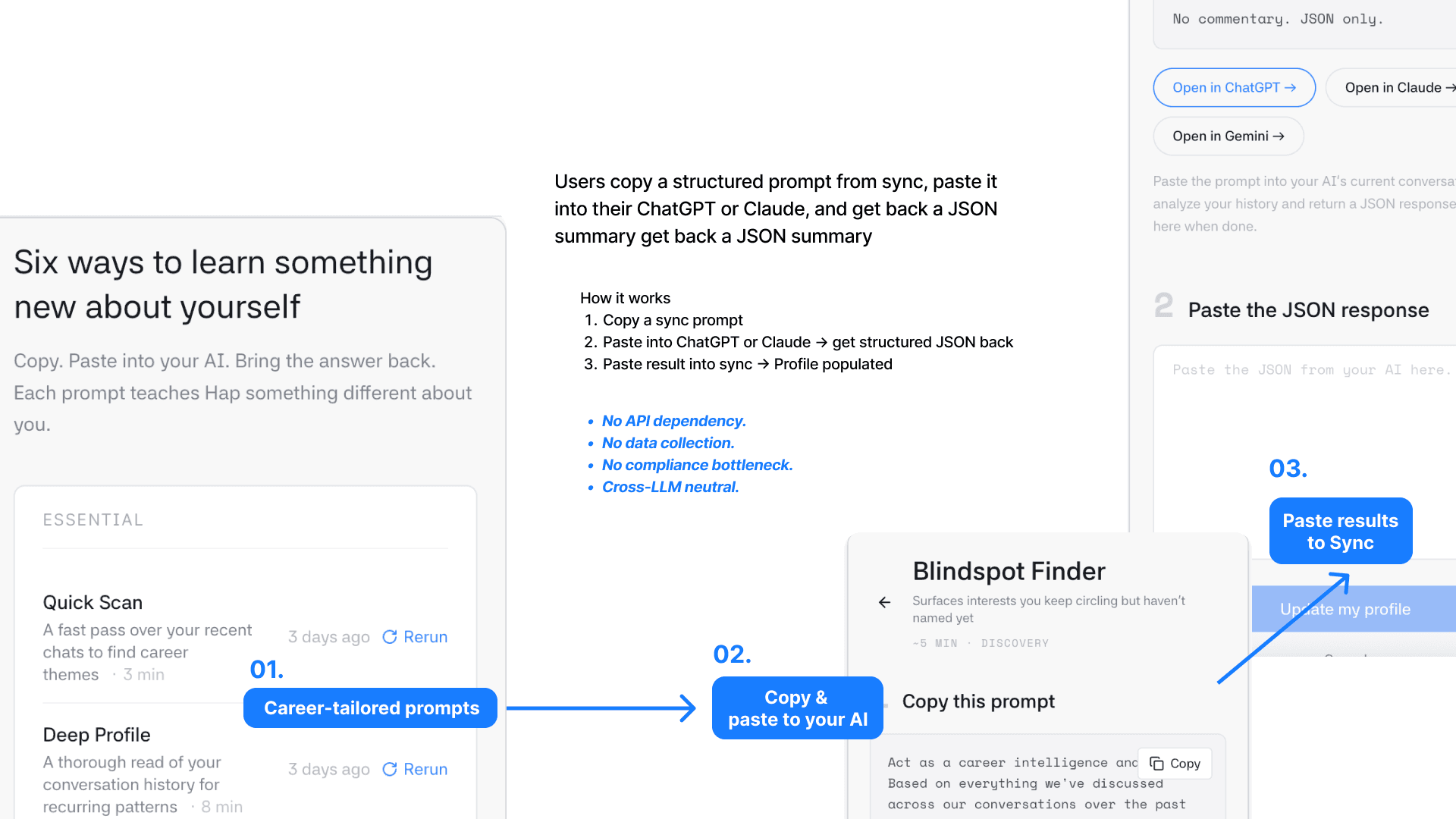
Because the hackathon timeline was short and trust was a key concern, we designed a copy-and-paste workflow instead of relying on direct API access.
Users could bring their own AI tool, generate a structured response, and paste it back into Sync to populate their profile.
Because the hackathon timeline was short and trust was a key concern, we designed a copy-and-paste workflow instead of relying on direct API access.
Users could bring their own AI tool, generate a structured response, and paste it back into Sync to populate their profile.
Personal Context Engine
Personal Context Engine
The profile translates AI conversation history into career-relevant signals. Instead of relying only on resumes or self-reported filters, Sync looks at goals, interests, location preferences, industries, and recurring thinking patterns.
This allows recommendations to go beyond what a user has already written on a resume.
The profile translates AI conversation history into career-relevant signals. Instead of relying only on resumes or self-reported filters, Sync looks at goals, interests, location preferences, industries, and recurring thinking patterns.
This allows recommendations to go beyond what a user has already written on a resume.
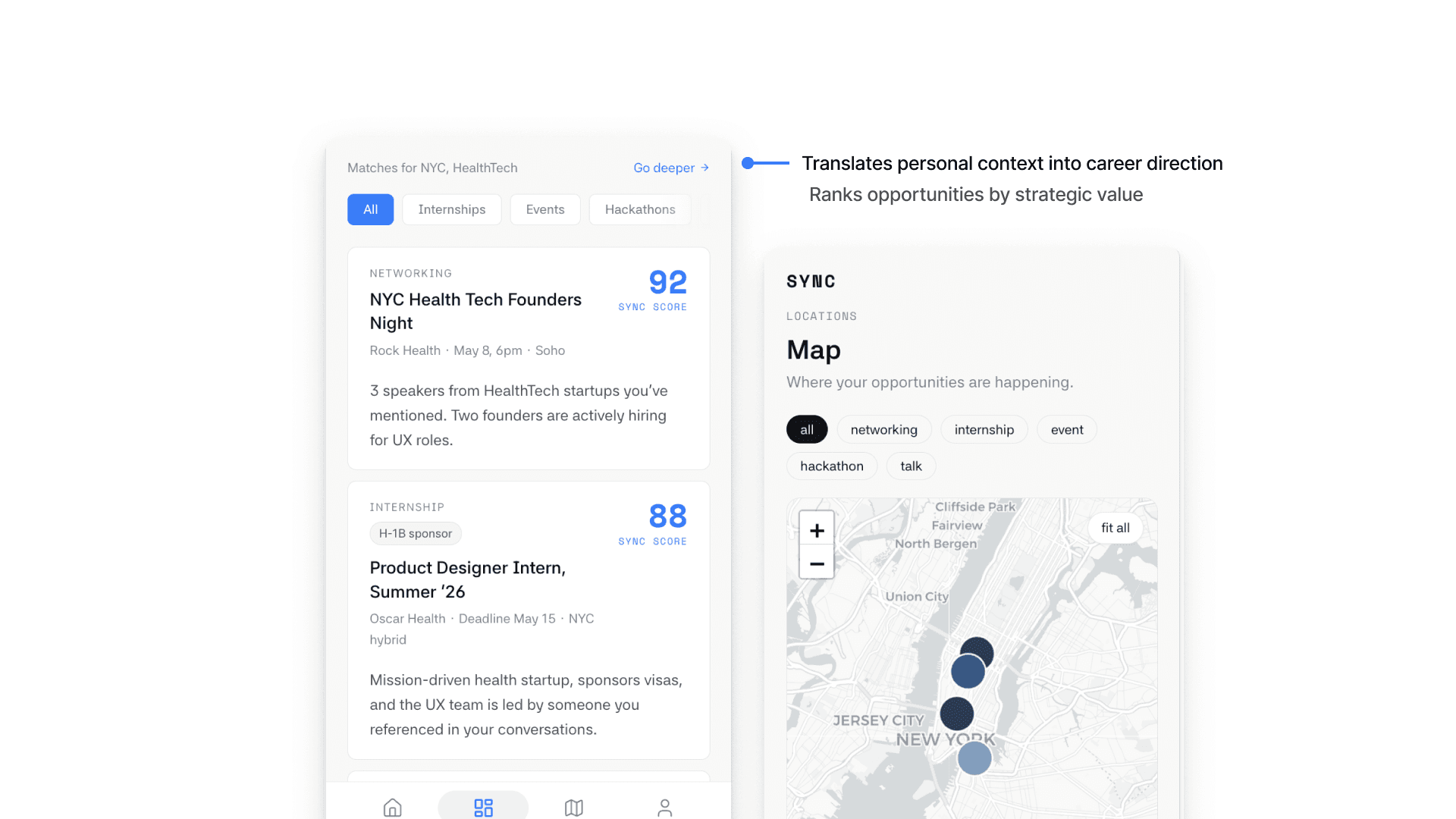
Intent-Based Career Discovery
Intent-Based Career Discovery
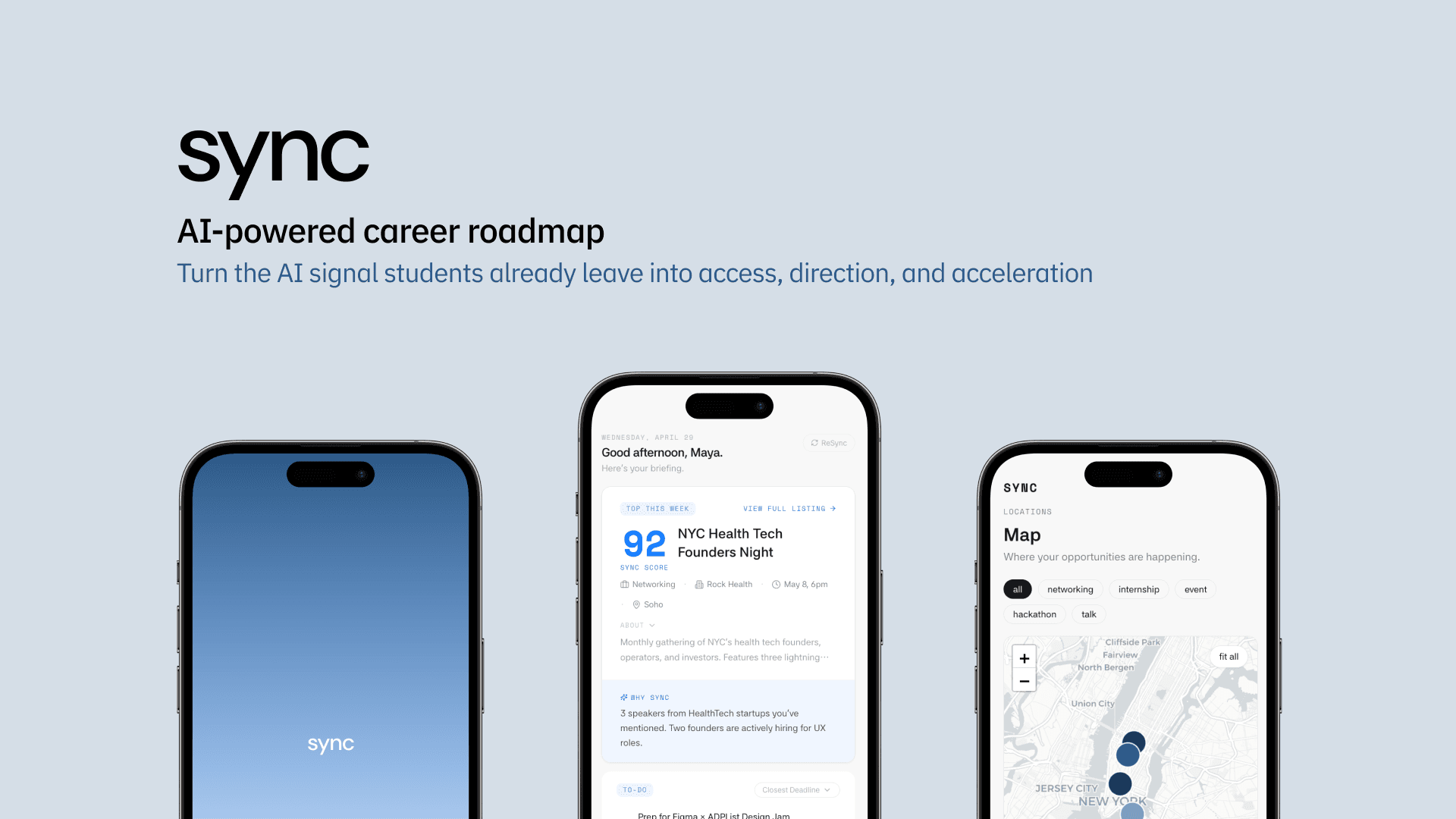
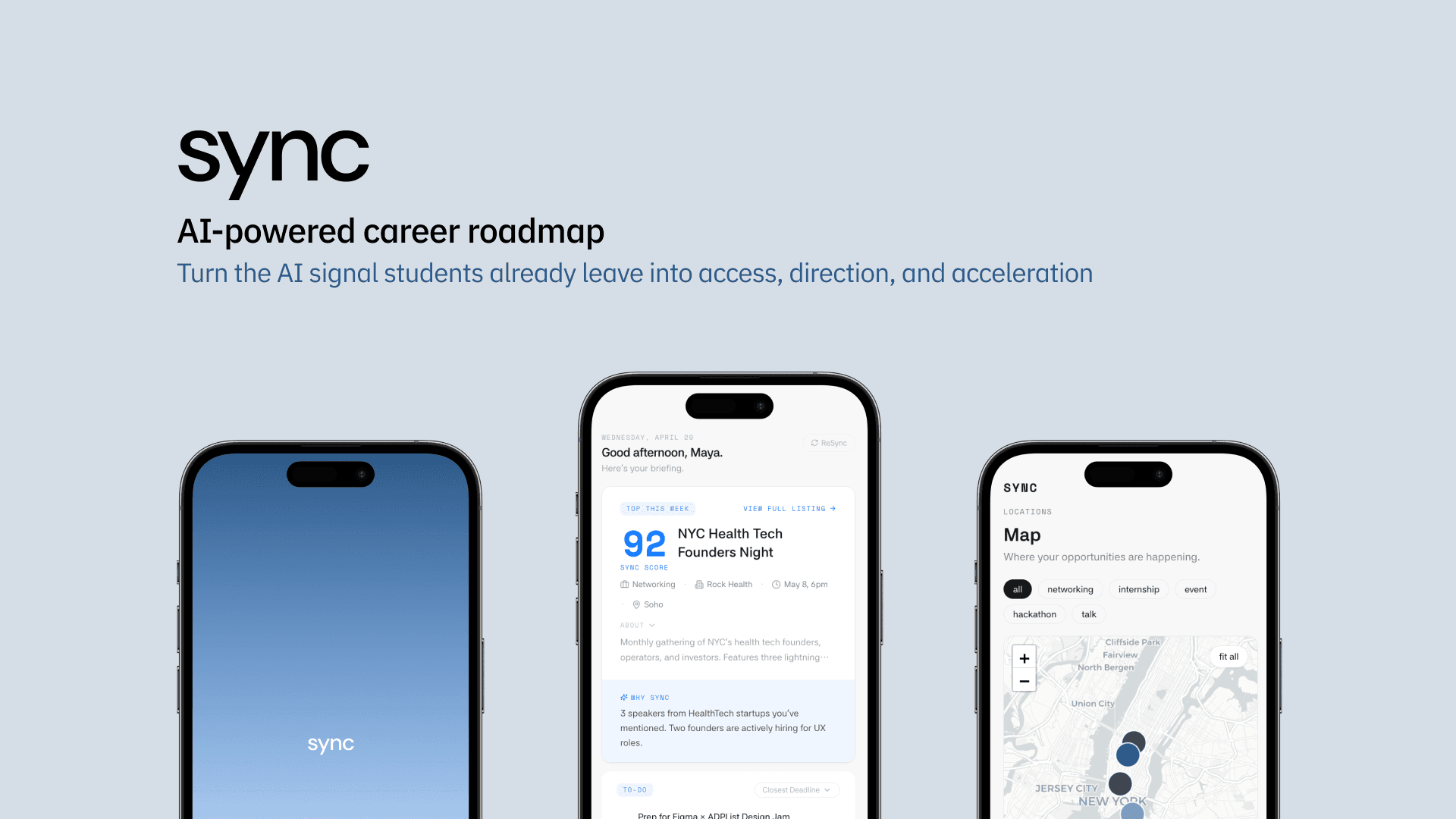
Sync ranks opportunities by how well they align with the user’s goals and long-term direction. Instead of showing a flat list of jobs, the product helps users understand which opportunities are strategically meaningful.
Sync ranks opportunities by how well they align with the user’s goals and long-term direction. Instead of showing a flat list of jobs, the product helps users understand which opportunities are strategically meaningful.
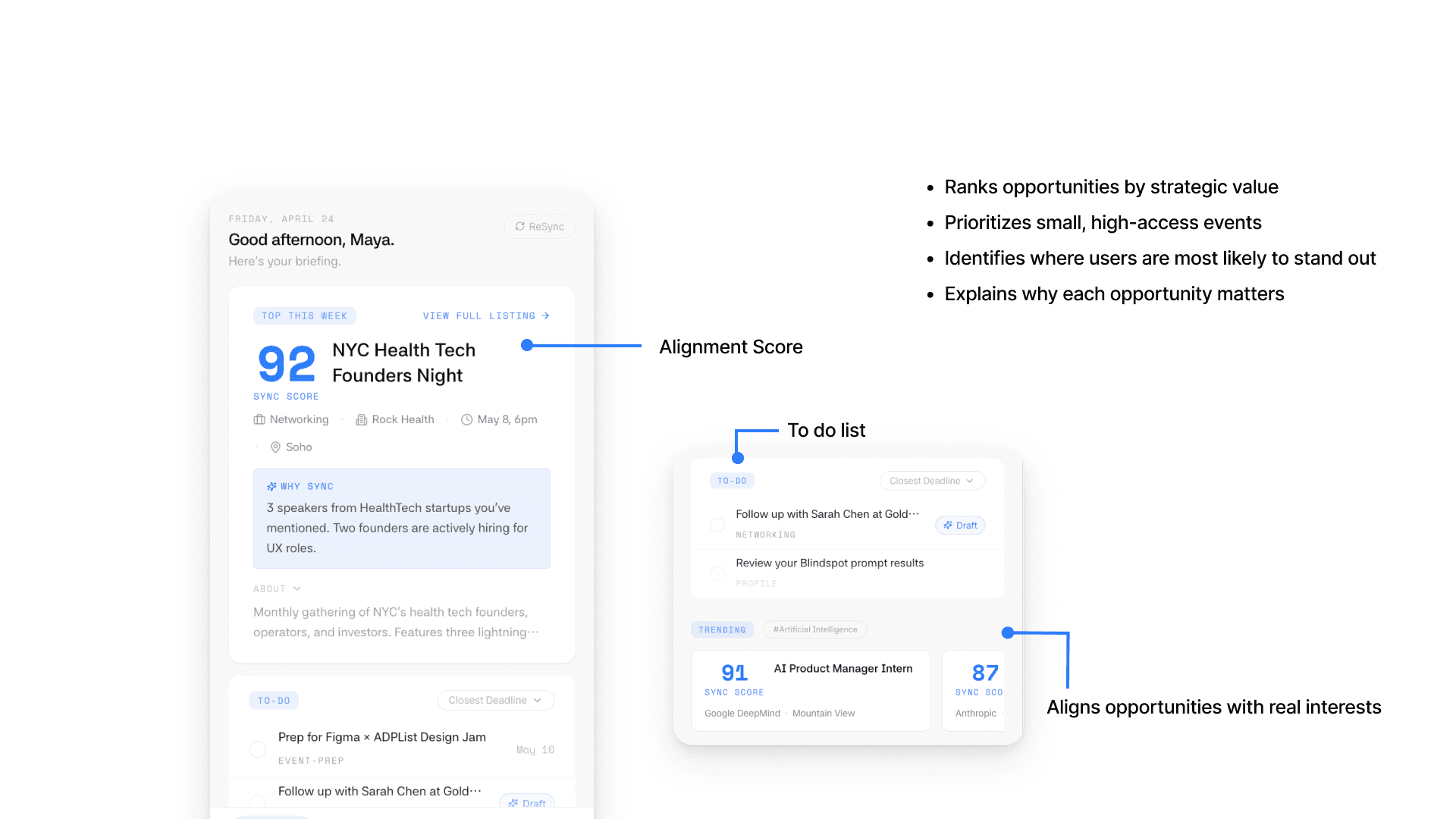
High-Leverage Opportunity Matching
High-Leverage Opportunity Matching
Not every opportunity has the same value for every student. Sync highlights smaller, high-access opportunities where the user may be more likely to stand out.
Each recommendation explains why it matters and what action the user can take next.
Not every opportunity has the same value for every student. Sync highlights smaller, high-access opportunities where the user may be more likely to stand out.
Each recommendation explains why it matters and what action the user can take next.
REFLECTION
What I learned
What I learned
Framing matters before features
This project reminded me that the strongest product direction often comes before the interface. Once we reframed the problem from “help students find more jobs” to “help students move with clearer career direction,” the product logic became much easier to define.
AI recommendations need visible reasoning
Because career decisions are personal and high-stakes, users need to understand why something is being recommended. The alignment score, “why sync” explanation, and to-do list were designed to make AI-driven suggestions feel more transparent and actionable.
Vibe coding works best with clear product logic
Building with Base44 helped us move quickly from concept to prototype, but speed only worked because the system was clearly defined first. The experience taught me that rapid prototyping is most effective when strategy, flows, and interface decisions evolve together.
Grateful for the teamwork
Grateful for the teamwork
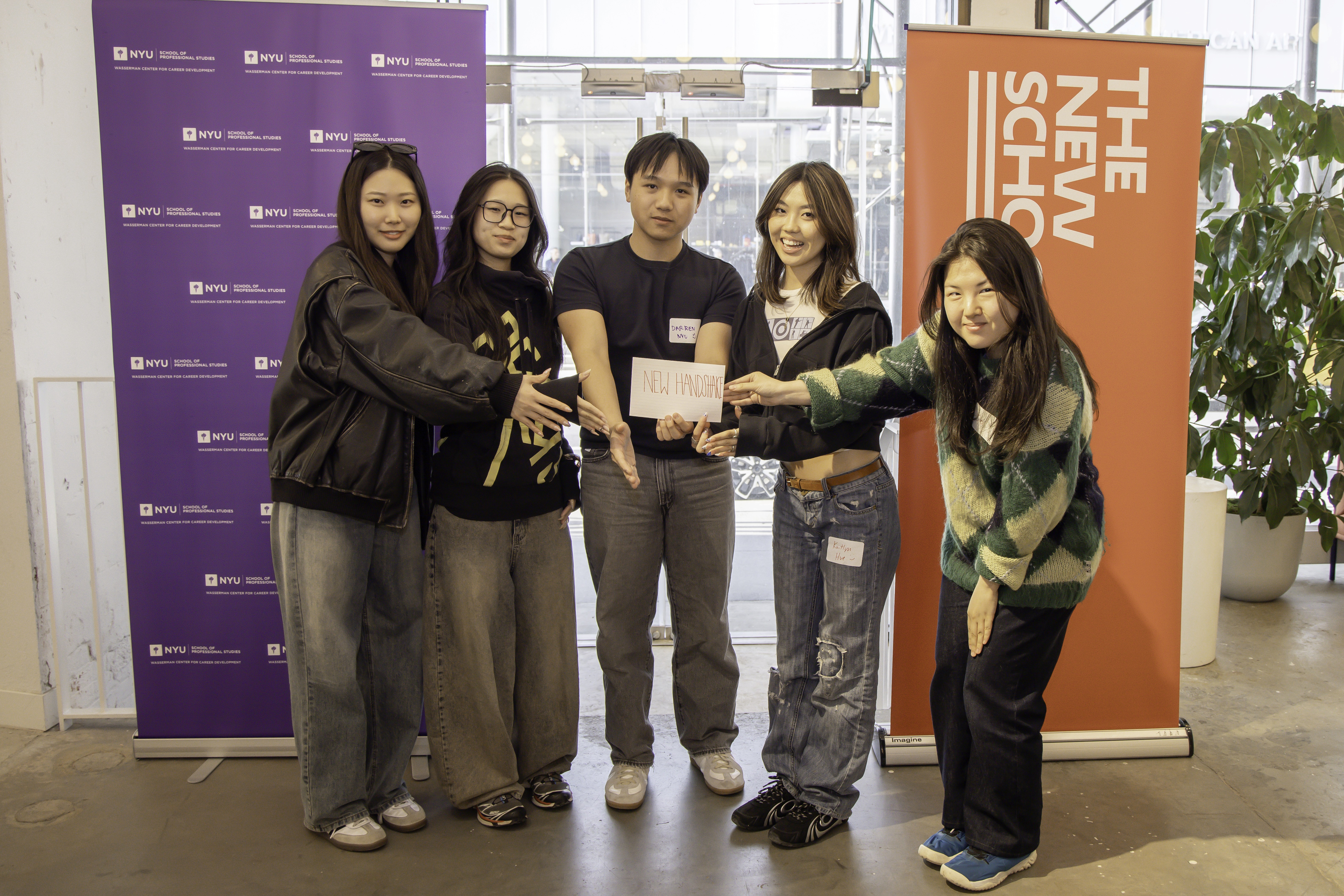
This project came together through close collaboration with Kaitlyn, Jo, Darren, and Julia during The Cross Campus 44 Hackathon.
Because we had only one day, the team had to move quickly from problem framing to product direction, interface design, and prototype execution. I’m grateful for how everyone contributed different perspectives across strategy, design, and development, helping turn an abstract idea into a working product narrative.
I’m also thankful to the organizers of The Cross Campus 44 Hackathon for creating a space where teams could experiment quickly, collaborate openly, and bring early ideas to life.
What made the process meaningful was not just the final prototype, but the way the team aligned around one core question: how might we turn the signals students already leave behind into clearer access, direction, and momentum?
This project came together through close collaboration with Kaitlyn, Jo, Darren, and Julia during The Cross Campus 44 Hackathon.
Because we had only one day, the team had to move quickly from problem framing to product direction, interface design, and prototype execution. I’m grateful for how everyone contributed different perspectives across strategy, design, and development, helping turn an abstract idea into a working product narrative.
I’m also thankful to the organizers of The Cross Campus 44 Hackathon for creating a space where teams could experiment quickly, collaborate openly, and bring early ideas to life.
What made the process meaningful was not just the final prototype, but the way the team aligned around one core question: how might we turn the signals students already leave behind into clearer access, direction, and momentum?