platform | mobile | B2C
platform | mobile | B2C
Instagram Saved: From Passive Storage to Active Retrieval
Instagram Saved: From Passive Storage to Active Retrieval
Instagram Saved: From Passive Storage to Active Retrieval
Role
Product Designer
Product Designer
User Research, UX Design, Prototyping & Testing
User Research, UX Design, Prototyping & Testing

Overview
Turning Instagram Saved from passive storage into an active retrieval surface
Turning Instagram Saved from passive storage into an active retrieval surface
In usability testing, only 1 in 3 users were able to retrieve a saved post using the current Saved experience. As saved content scales, retrieval failure reduces the long-term value of saving.
This case study focuses on design decision-making and evaluation through user testing.
In usability testing, only 1 in 3 users were able to retrieve a saved post using the current Saved experience. As saved content scales, retrieval failure reduces the long-term value of saving.
This case study focuses on design decision-making and evaluation through user testing.
What's in this project
This project documents how I identified retrieval failure in Instagram Saved, explored multiple solution directions, and validated a search-based approach as the most effective retrieval model through comparative usability testing.
It focuses on design decision-making across problem framing, solution trade-offs, and outcome evaluation using measurable user behavior.
This project documents how I identified retrieval failure in Instagram Saved, explored multiple solution directions, and validated a search-based approach as the most effective retrieval model through comparative usability testing.
It focuses on design decision-making across problem framing, solution trade-offs, and outcome evaluation using measurable user behavior.
Problem & User Signals
Saved content grows quickly, but retrieval breaks down as collections scale. Saving is frictionless, but finding saved posts later often fails.
Saved content grows quickly, but retrieval breaks down as collections scale. Saving is frictionless, but finding saved posts later often fails.
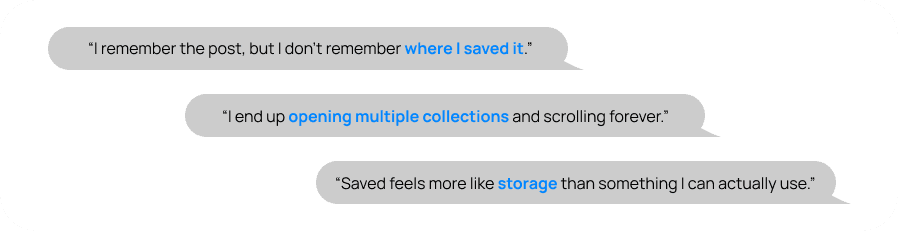
These signals were captured from heavy Instagram users (20+ hrs/week) and online discussions. Across users, retrieval failures consistently showed the same pattern: users remembered the content, not the location where it was saved.
As a result, Saved relies heavily on users’ memory of structure, rather than supporting how they actually remember content.
These signals were captured from heavy Instagram users (20+ hrs/week) and online discussions. Across users, retrieval failures consistently showed the same pattern: users remembered the content, not the location where it was saved.
As a result, Saved relies heavily on users’ memory of structure, rather than supporting how they actually remember content.
Design Goal
Reduce retrieval failure in Instagram Saved as saved content scales, by supporting how users remember content rather than where it is stored.
Reduce retrieval failure in Instagram Saved as saved content scales, by supporting how users remember content rather than where it is stored.
Exploring Possible Solutions
Before committing to a specific solution, I explored multiple ways users might retrieve saved content, focusing on where retrieval was breaking down.
Before committing to a specific solution, I explored multiple ways users might retrieve saved content, focusing on where retrieval was breaking down.

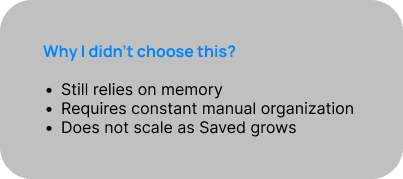
A. Refining Collections
A. Refining Collections
A. Refining Collections
Improve folder structure with more hierarchy
Improve folder structure with more hierarchy
Improve folder structure with more hierarchy
B. Manual Tagging
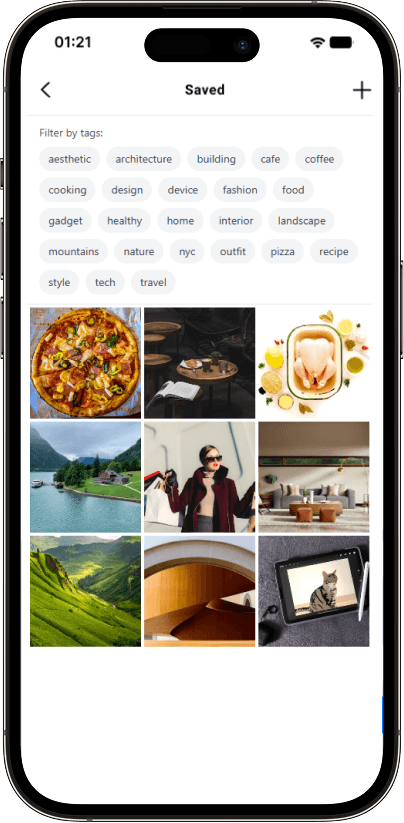
B. Manual Tagging
B. Manual Tagging
Allow users to manually tag saved posts
Allow users to manually tag saved posts
Allow users to manually tag saved posts
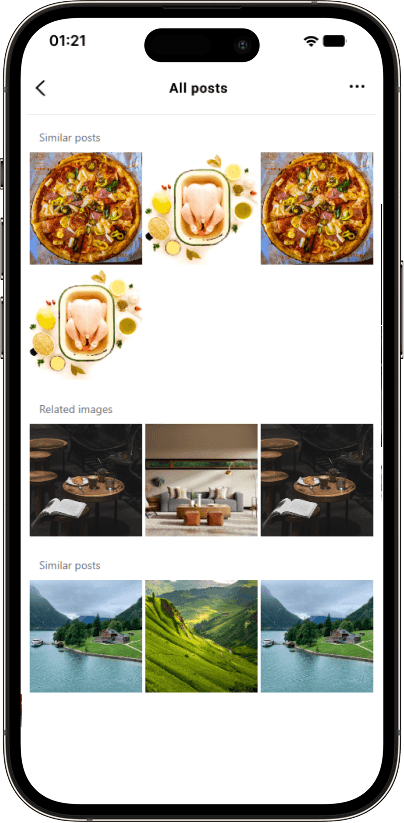
C. Visual Browsing
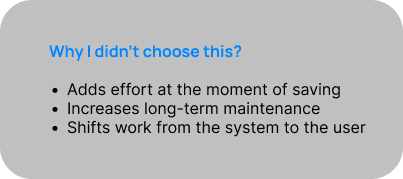
C. Visual Browsing
C. Visual Browsing
Suggest saved posts based on visual similarity
Suggest saved posts based on visual similarity
Suggest saved posts based on visual similarity
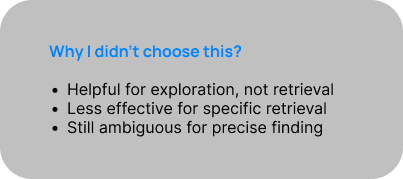
Across these explorations, one pattern consistently emerged.
Users didn’t remember where a post was saved or how it was organized.
They remembered what the content was about.
This made search a more natural entry point for retrieval than folders, tags, or visual grouping. The design direction shifted toward a search-based approach focused on content and meaning, rather than structure.
Across these explorations, one pattern consistently emerged.
Users didn’t remember where a post was saved or how it was organized.
They remembered what the content was about.
This made search a more natural entry point for retrieval than folders, tags, or visual grouping. The design direction shifted toward a search-based approach focused on content and meaning, rather than structure.
Refining the Chosen Direction
Rather than simply adding search, I explored two search-based variations to understand how different entry points affect retrieval behavior.
Both concepts support retrieving saved content based on what users remember. The key difference lies in how much guidance the system provides at the moment of search.
Rather than simply adding search, I explored two search-based variations to understand how different entry points affect retrieval behavior.
Both concepts support retrieving saved content based on what users remember. The key difference lies in how much guidance the system provides at the moment of search.
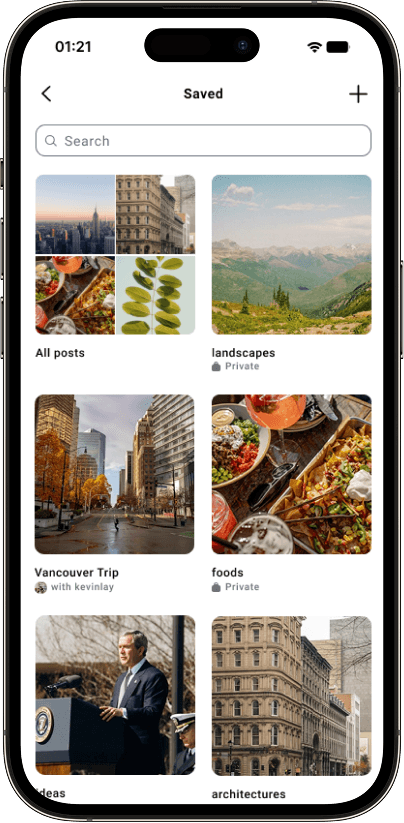
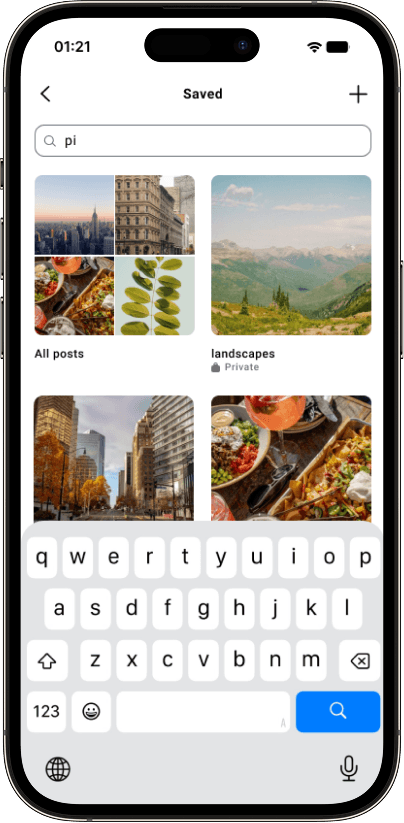
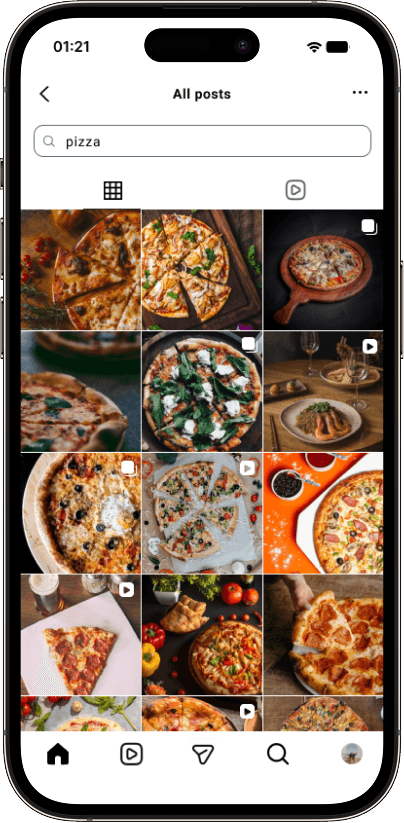
A search bar is added to the top of Saved, allowing users to retrieve content by typing keywords such as “pizza".
Results update dynamically as users type, with minimal changes to the existing UI.
This concept establishes the baseline value of search as a retrieval tool, without additional system guidance.
A search bar is added to the top of Saved, allowing users to retrieve content by typing keywords such as “pizza".
Results update dynamically as users type, with minimal changes to the existing UI.
This concept establishes the baseline value of search as a retrieval tool, without additional system guidance.
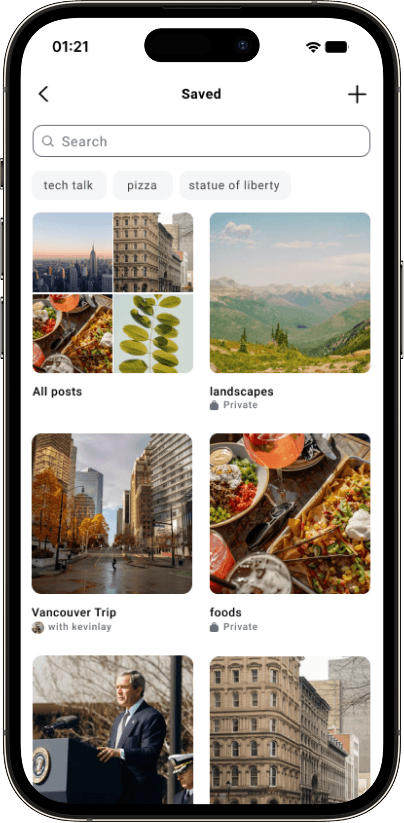
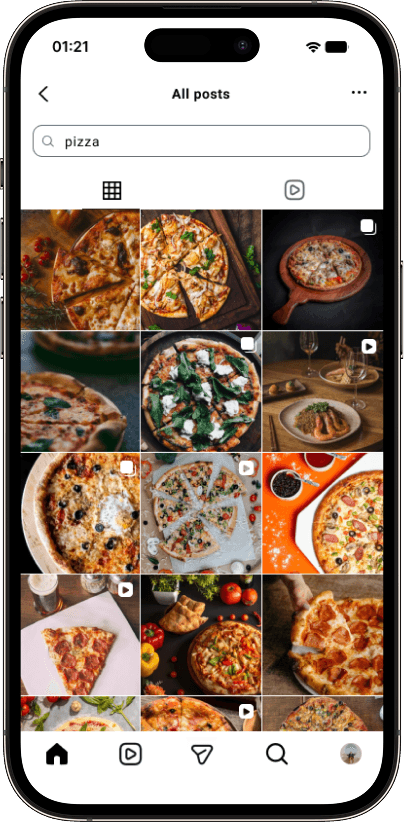
Search is combined with suggested keywords generated from frequent saving patterns, allowing users to start retrieval with a tap instead of typing.
By reducing the effort required to recall or formulate a query, this concept tests whether system-provided guidance can further reduce cognitive load and improve retrieval speed.
Search is combined with suggested keywords generated from frequent saving patterns, allowing users to start retrieval with a tap instead of typing.
By reducing the effort required to recall or formulate a query, this concept tests whether system-provided guidance can further reduce cognitive load and improve retrieval speed.
Design Study
An unmoderated usability test was conducted in Maze to compare three retrieval experiences under the same conditions.
AS-IS — the current browsing-based Saved experience
TO-BE A — search-only retrieval
TO-BE B — search with suggested keywords
An unmoderated usability test was conducted in Maze to compare three retrieval experiences under the same conditions.
AS-IS — the current browsing-based Saved experience
TO-BE A — search-only retrieval
TO-BE B — search with suggested keywords
Participants were "regular to heavy users of Instagram Saved" based in the US.
Participants were "regular to heavy users of Instagram Saved" based in the US.
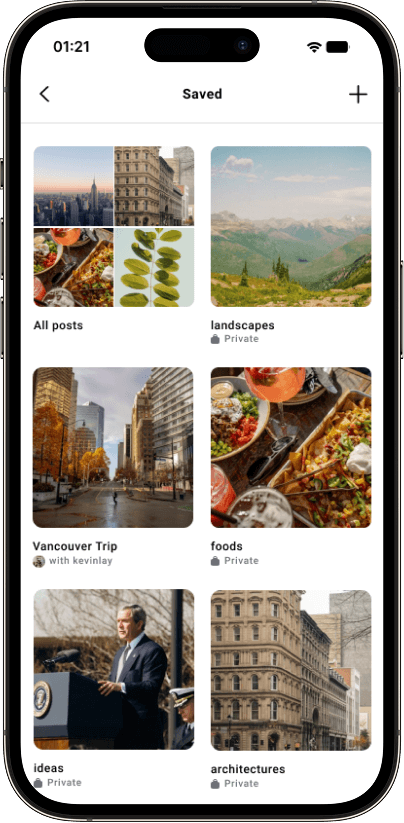
AS IS
TO-BE A
TO-BE B
All participants completed the same retrieval task across all three conditions:
"Find a saved post related to ‘pizza’
This setup enabled direct comparison of efficiency, accuracy, and user confidence without confounding variables.
All participants completed the same retrieval task across all three conditions:
"Find a saved post related to ‘pizza’
This setup enabled direct comparison of efficiency, accuracy, and user confidence without confounding variables.
Success Metrics
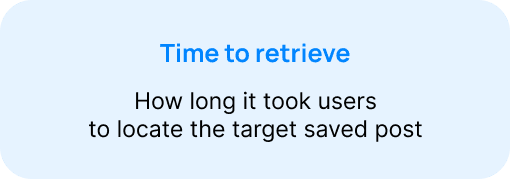
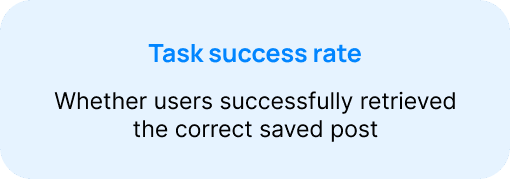
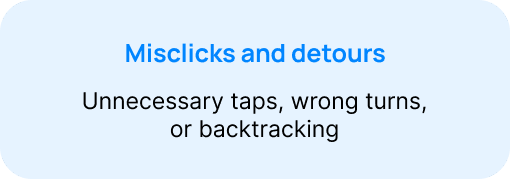
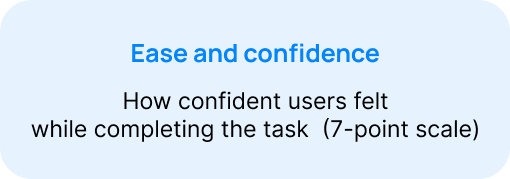
To evaluate each approach, I focused on observable retrieval behavior rather than preference, using metrics that reflect how users actually find saved content.
To evaluate each approach, I focused on observable retrieval behavior rather than preference, using metrics that reflect how users actually find saved content.
Validation
Search with suggested keywords (TO-BE B) significantly improved retrieval performance across all key metrics compared to the current Saved experience.
Search with suggested keywords (TO-BE B) significantly improved retrieval performance across all key metrics compared to the current Saved experience.
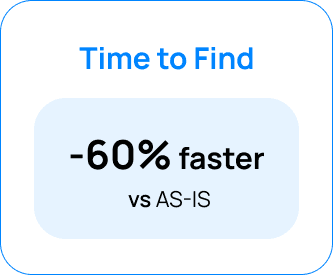
Users completed retrieval 60% faster compared to the AS-IS experience.
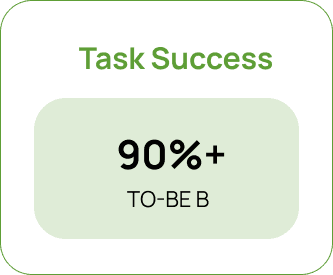
90%+ of users successfully retrieved the correct saved post in TO-BE B.
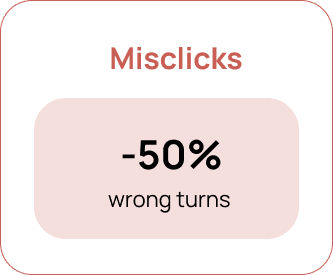
Wrong turns and unnecessary actions dropped by 50%, indicating more direct retrieval paths.
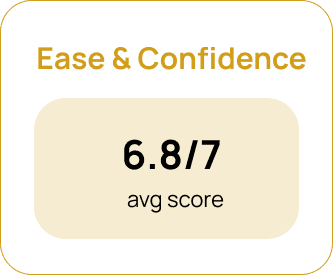
Users reported an average score of 6.8 / 7, the highest across all conditions.
Users completed retrieval 60% faster compared to the AS-IS experience.
Users completed retrieval 60% faster compared to the AS-IS experience.
90%+ of users successfully retrieved the correct saved post in TO-BE B.
90%+ of users successfully retrieved the correct saved post in TO-BE B.
Wrong turns and unnecessary actions dropped by 50%, indicating more direct retrieval paths.
Wrong turns and unnecessary actions dropped by 50%, indicating more direct retrieval paths.
Users reported an average score of 6.8 / 7, the highest across all conditions.
Users reported an average score of 6.8 / 7, the highest across all conditions.
Recommendation Likelihood (Proxy NPS)
Search with suggested keywords (TO-BE B) showed a strong increase in users’ willingness to recommend the experience.
Average recommendation score increased from 4.4 (AS-IS) to 8.3 (TO-BE B).
This shift aligns with improvements in task success, speed, and reduced cognitive effort.
Users were more likely to recommend TO-BE B not because results were simply better, but because the system reduced decision-making effort at the start of retrieval.
Search with suggested keywords (TO-BE B) showed a strong increase in users’ willingness to recommend the experience.
Average recommendation score increased from 4.4 (AS-IS) to 8.3 (TO-BE B).
This shift aligns with improvements in task success, speed, and reduced cognitive effort.
Users were more likely to recommend TO-BE B not because results were simply better, but because the system reduced decision-making effort at the start of retrieval.
Preference Result
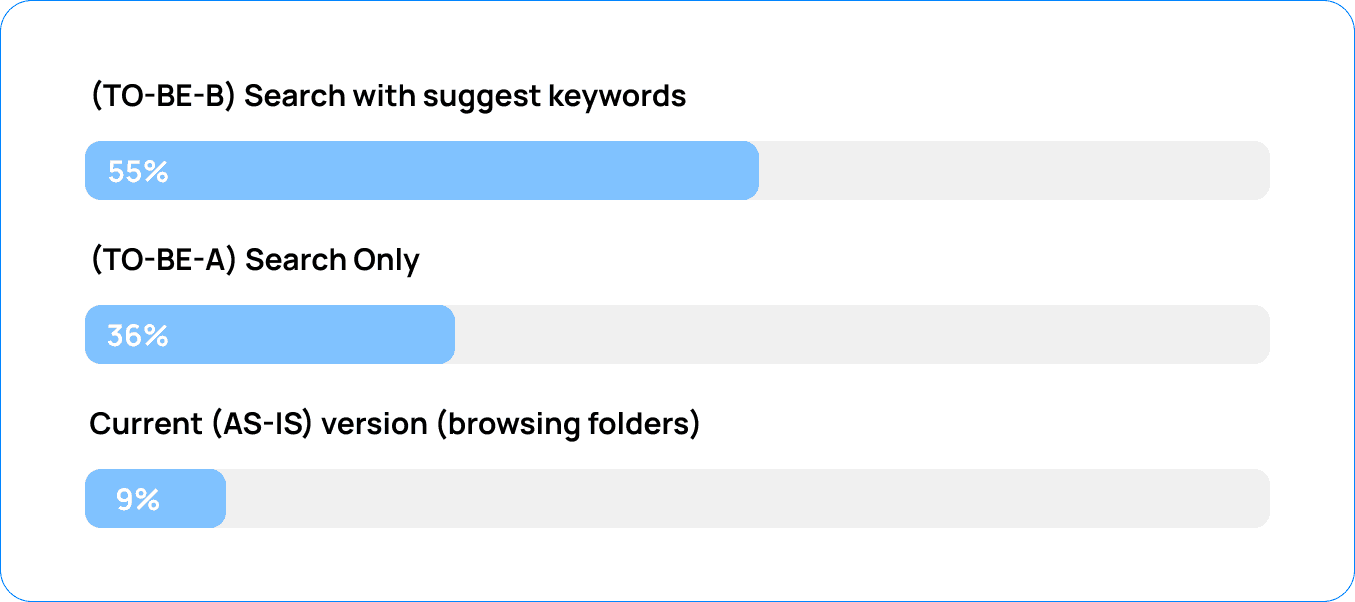
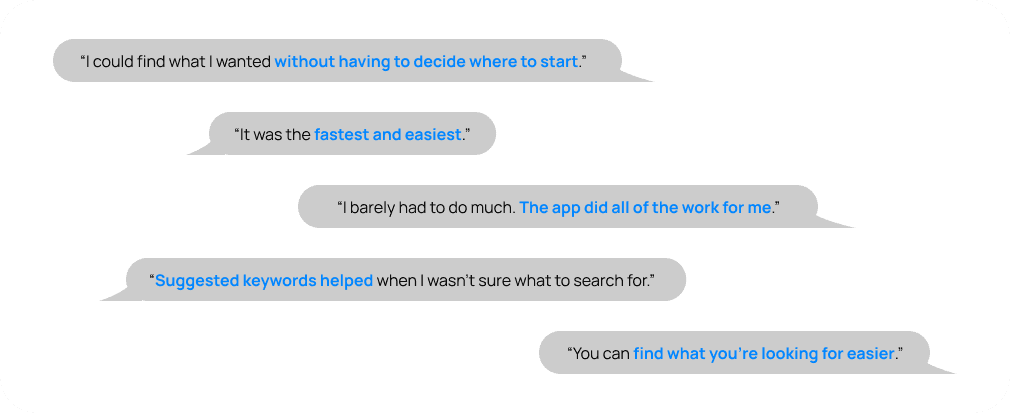
Why users chose TO-BE B
Users preferred TO-BE B because they didn’t have to decide where to start.
Users preferred TO-BE B because they didn’t have to decide where to start.
Key Findings
1. Search significantly reduced retrieval time
TO-BE B (Search + Suggested Keywords) reduced task completion time by ~60% compared to AS-IS
Compared to TO-BE A (Search only), TO-BE B was still ~25% faster
TO-BE B (Search + Suggested Keywords) reduced task completion time by ~60% compared to AS-IS
Compared to TO-BE A (Search only), TO-BE B was still ~25% faster
→ Suggested keywords helped users start faster and avoid hesitation
→ Suggested keywords helped users start faster and avoid hesitation
2. Task success rate increased as guidance was added
AS-IS: ~55-60% task success rate
TO-BE A: ~80% success rate
TO-BE B: ~90%+ success rate
AS-IS: ~55-60% task success rate
TO-BE A: ~80% success rate
TO-BE B: ~90%+ success rate
→ Search alone improved outcomes, but guided entry points further reduced failure.
→ Search alone improved outcomes, but guided entry points further reduced failure.
3. Misclicks and detours dropped sharply
In the AS-IS flow, users frequently:
Opened multiple collections
Backtracked
Scrolled through unrelated grids
In the AS-IS flow, users frequently:
Opened multiple collections
Backtracked
Scrolled through unrelated grids
TO-BE B reduced misclicks and detours by ~50% compared to AS-IS
TO-BE B reduced misclicks and detours by ~50% compared to AS-IS
→ Fewer wrong turns meant less cognitive effort and faster completion.
→ Fewer wrong turns meant less cognitive effort and faster completion.
4. TO-BE B showed the highest ease and confidence
4. TO-BE B showed the highest ease and confidence
(Self-reported, 7-point scale)
AS-IS: ~3.0–3.5
TO-BE A: ~5.2
TO-BE B: ~6.1–6.8
(Self-reported, 7-point scale)
AS-IS: ~3.0–3.5
TO-BE A: ~5.2
TO-BE B: ~6.1–6.8
→ Users felt more confident because they didn’t have to decide where to start.
→ Users felt more confident because they didn’t have to decide where to start.
What I learned
Retrieval is as important as saving
Users remember content better than structure
Small UX changes can unlock system-level improvements
Designing the test is part of the design work
Retrieval is as important as saving
Users remember content better than structure
Small UX changes can unlock system-level improvements
Designing the test is part of the design work
Retrieval is as important as saving
Users remember content better than structure
Small UX changes can unlock system-level improvements
Designing the test is part of the design work